Witness, Spokesperson or Record: Three Different Source Roles
Understand witness, spokesperson and record roles in rural reporting so you can judge what each source can establish, what it leaves open and what to seek next.
The common mistake in rural reporting is to treat the first named source as the whole account: a witness saw something, a representative explained it, or a document recorded it, so the story seems settled. That shortcut can leave out what the source could not know, had a reason to emphasise, or was never designed to record. Reading a countryside story well starts with a more useful question: what role is each source playing?
Match the source to the question you need answered
A direct witness, an interested representative and a documentary record offer different kinds of evidence. None is automatically complete, and none is automatically unreliable. Their value depends on the claim being made and the limits of what the source could observe or establish.
A witness can describe what they personally saw, heard or did. A representative can explain an organisation’s position, decisions or stated intentions. A record can show what was entered, agreed, published or formally logged. Those distinctions matter in rural coverage, where a report may concern a scattered community, a local service, a land-use dispute or an incident on a working farm.
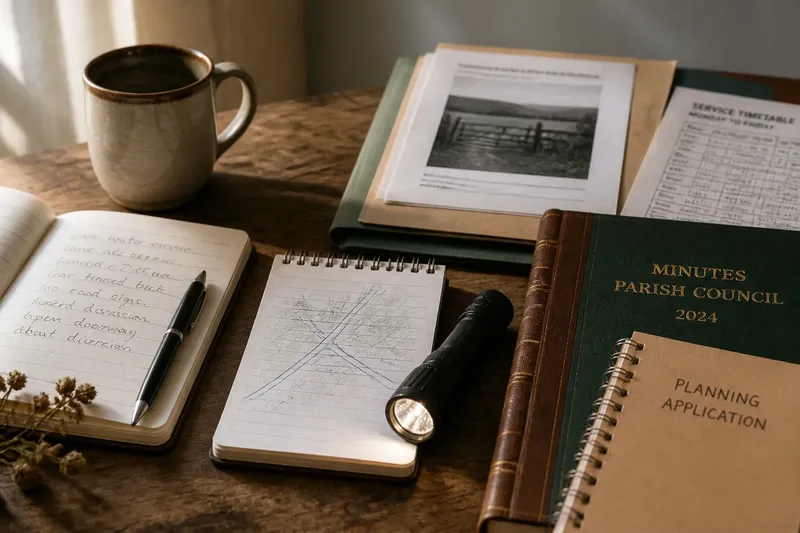
Think of the three as different tools in a shed: a torch helps you see a particular corner, a notice tells you what someone wants others to know, and a ledger preserves entries made for a specific purpose. Each can be useful; none illuminates every part of the situation.
Use a witness when the question is about direct experience
For a claim about what happened in someone’s presence, a witness may be the closest source to the event. A resident might describe hearing a warning siren, a passenger might recall a bus turning back, or a farmer might explain what they saw at a field entrance. Their account can add sensory detail and show how an event affected someone on the ground.
Keep the boundary of that account visible. A person who saw water across a lane can speak to the condition of that stretch at that time; they may not know how far flooding extended, what caused it or whether an official closure was in force. A person who heard a discussion through an open doorway may report the words they heard, but not necessarily the decisions made elsewhere.
Witness accounts are also shaped by viewpoint, memory and attention. Two people standing in different places may notice different things without either deliberately misleading a reporter. When a story includes a vivid quotation, ask whether it supports a personal observation, a broader conclusion or both. The broader the conclusion, the more useful it is to look for other forms of evidence.
This role fits when: you want to understand what a person directly experienced, how an event appeared from a particular location, or what practical effect it had on them. Treat it more cautiously when the claim concerns a cause, a whole parish or a decision the witness did not take part in.
Use a representative when the question concerns an organisation
A spokesperson speaks on behalf of a council, business, landowner, campaign group, emergency service or other organisation. This source can clarify what the organisation says it has decided, why it says it acted, which service it says is operating, or how it responds to criticism. For a reader, that can distinguish an organisation’s public position from a resident’s account of its effect.
The representative is not simply a neutral observer of the organisation. Their role is to communicate its position, so the answer may focus on policy, responsibility or reassuring language rather than on every unresolved detail. That does not make the answer worthless. It does mean that “the council says” and “the work is complete” are different kinds of statements.
Notice the wording. “We are reviewing the route” describes a process, not a final decision. “The service is available” may refer to a timetable or formal offer, not whether a particular resident can reach it. A spokesperson can usually explain what their organisation intends or reports; a separate record or direct account may be needed to assess how that position works in practice.
This role fits when: you need the stated reason, policy, response or commitment of a named organisation. It is less suited to establishing what every affected person experienced or whether a promise has been carried out. Look for the exact organisation represented and whether the statement answers the question the story raises.
Use a record when the question concerns what was documented
A documentary record may be a meeting minute, planning notice, service timetable, inspection report, map, written agreement or public register. It can anchor a story to an entry that readers can inspect: a proposal was listed, a meeting recorded a decision, or a timetable set out a service. Unlike a recollection, a record can preserve wording and dates in a form that can be checked.
But a record is made for a purpose. Minutes may summarise discussion rather than reproduce it; a map may show an administrative boundary rather than how residents understand their community; a timetable states the service offered, not whether a journey is workable for a particular person. An absent entry is not automatically proof that an event did not happen. The document may cover a different period, area or kind of information.
For that reason, identify what the record is and what it records. A document titled as a draft, consultation notice or proposed plan should not be read as a final decision. A list of complaints can show that complaints were logged, but it cannot by itself settle their cause or describe people who did not submit one.
This role fits when: you need to check formal wording, a recorded decision, a published arrangement or the scope of an official process. It is less suited to explaining how the arrangement feels on the ground or what discussion a summary leaves out.
Choose the source role that fits your reading situation
Start with the claim that matters, not with a ranking of sources. If the story says a resident saw a vehicle cross a lane, a witness is relevant. If it says a district council changed a collection policy, the council’s representative can explain the stated decision, while minutes or a published notice may establish its recorded form. If it says households missed a collection, neither the policy statement nor the notice alone describes those households’ experiences.
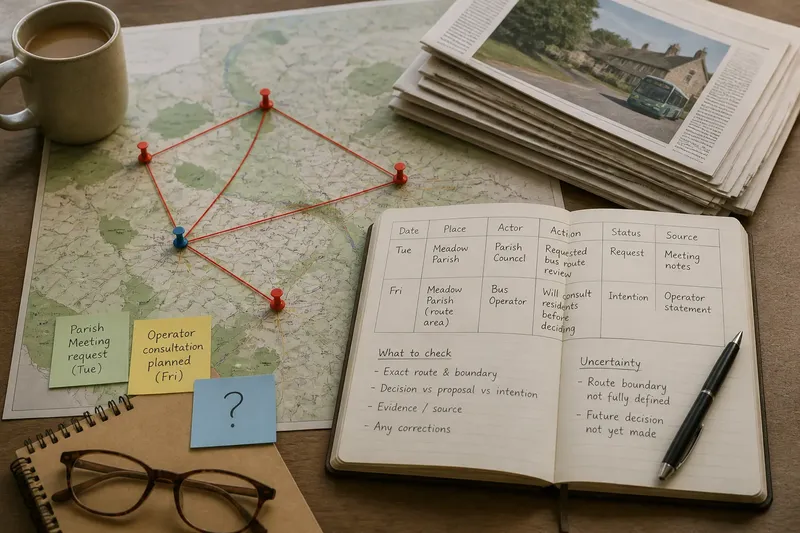
Say a rural news story reports that a village bus route is “being restored”. Imagine the article quotes a passenger who saw a bus on the road, includes a transport operator’s spokesperson describing a planned service, and links to a timetable. The witness can support that a bus passed at a particular point; the spokesperson can explain the operator’s stated plan; the timetable can show the service listed. To judge what “restored” means for a reader, check whether the route, stops and operating times in the document match the claim. Each source answers a different part, and the word itself needs careful reading.
Use these questions to sort a source quickly:
- Is the claim about what someone personally saw or experienced? Give the witness account weight within that person’s view, and avoid extending it to places or events they could not observe.
- Is the claim about an organisation’s position or intention? Use its representative for the stated position, and distinguish intention from completed action.
- Is the claim about a formal decision, published arrangement or recorded entry? Look for the relevant document and check its status, scope and wording.
- Does the story move from one person or document to a claim about a whole community? Ask what additional accounts or records would support that wider reach.
- Do two sources appear to disagree? Check whether they refer to the same place, period and question before treating the difference as a contradiction.
Questions that clarify what a source can establish?
Is a witness account more reliable than a document?
Not by default. A witness may be best placed to describe a direct experience, while a document may be better for checking what was formally recorded; each has a different scope and possible gaps.
Does a spokesperson’s statement count as evidence?
It is evidence of the organisation’s stated position and may provide useful explanations or commitments. It does not, by itself, establish that the position is complete or that an intended action has happened.
What should I do if a record conflicts with someone’s account?
Check whether they concern the same time, place and event, and whether the record is a draft, summary or final entry. A record may not capture a person’s experience, while a recollection may not settle what was formally entered.
How can I tell whether a source is being stretched too far?
Compare the source’s direct knowledge with the breadth of the sentence it supports. If a single account is used to describe a whole district, or a policy statement is treated as proof of its effects, the claim may reach beyond that source’s role.
Read for the gap between a source and the claim
Source labels help, but the wording around them matters just as much. “A resident said”, “the company stated” and “the minutes record” tell you who is speaking and what kind of support is offered. Verbs such as “saw”, “plans”, “approved” and “delivered” make different claims; do not let a strong verb borrow certainty from a source that cannot support it.
When a story names several sources, ask whether they genuinely add different kinds of knowledge or repeat the same position. Several representatives may all speak for organisations with related interests; several witnesses may share one viewpoint; a document may record a decision described by the spokesperson. More voices do not necessarily mean more independent ways of checking the claim.
For rural news literacy, the useful habit is to match source role to claim, then notice what remains unanswered. A witness can make a place and experience more legible, a representative can explain an organisation’s account, and a record can fix formal wording in view. The next useful question is often modest: which part of this story is directly supported, and which part still needs a source with a different view?