What a Headline Can Tell You Before You Open the Story
Learn how a rural news headline frames an issue, spot what it leaves unsaid and compare its promise with the article’s actual scope.

The most common mistake with a rural news headline is treating its sharpest phrase as the whole report. A headline about a “farm crisis”, “village revolt” or “road in chaos” may turn a limited event into a sweeping claim, leading readers to share or remember a story as broader than its evidence. Reading the wording as a frame—not a verdict—helps you see what the report promises before you decide what it establishes.
Read the headline as a claim with a boundary
A headline makes a compact claim: something happened, matters, or is changing. Its boundary is the group, place and period that the wording appears to cover. Those boundaries may be explicit, as in “Residents of Moor End oppose quarry plan”, or left for the reader to infer from a broader phrase such as “Rural communities fight quarry”.
Look for the nouns that set the scale. “Residents”, “farmers”, “the council” and “the countryside” are not interchangeable. A report about comments from several residents does not, on that basis alone, speak for every household in a parish. The headline may be accurate as shorthand while still inviting a wider reading than the article supports.
Geography can also change the apparent reach. “County warns of water pressure” might concern a particular supply area rather than every village in the county. Notice whether the headline names a settlement, district, service area or just a broad region; the smaller and more precise label often matters to a reader deciding whether the story affects their own place.
Notice which words carry the strongest emphasis
Verbs and adjectives supply much of a headline’s force. “Closes”, “threatens”, “rejects” and “slashes” suggest different kinds of action, while “historic”, “rural”, “controversial” and “crisis” guide the reader towards a judgement. Ask what observable event the word describes. If that is not clear from the headline, keep the implied interpretation provisional until you read the report.
Pay attention to agency, too. “Bridge shut after flood” names an outcome but may not say who made the decision or whether the closure is temporary. “Council shuts bridge” identifies an actor, yet may conceal that the council is responding to a safety assessment or an instruction from another body. A headline has little room for the chain of decisions behind an action.
Small words can alter the claim just as much as dramatic ones. “May”, “plans to” and “set to” signal expectation or intention, not a completed change. “Could lose” is not the same as “has lost”. If a headline drops these qualifiers for brevity, check the opening paragraphs to see whether the event is proposed, under way or already confirmed.
Check who or what the headline makes visible
A headline has to select a focus, and that choice can leave relevant people or conditions out of view. “Market town backs new bypass” might foreground support while omitting disagreement, the limits of the consultation or the fact that “backs” refers to a decision by one organisation. The article may supply those details, but the headline cannot be assumed to contain them.
Look for collective labels that turn a few voices into a group. “Villagers demand action” sounds like a shared position; the report may describe a petition, a meeting or one campaign group. That does not make the headline automatically false. It does mean you should ask whose position is being reported and whether the story identifies how widely it is held.
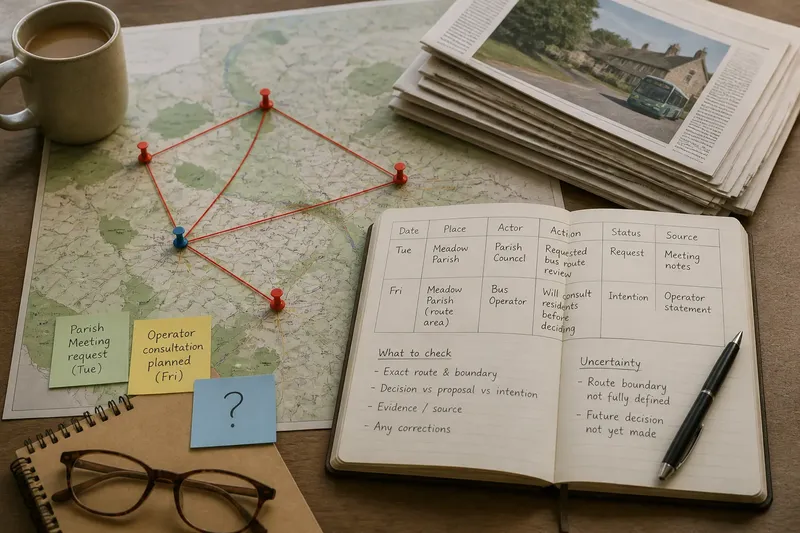
Numbers and comparisons can be narrowed by omission as well. A headline might say that a rural bus service is “cut”, without showing whether the change affects one route, a particular timetable or the whole network. The useful question is not simply “What is missing?” but “Which omitted detail could change the scale or meaning of this claim?”
Separate the headline’s promise from the report’s scope
The promise is the impression a reader could reasonably take from the headline. The scope is what the article actually examines: its location, time period, people, evidence and limits. Comparing them is a quick way to avoid making a narrow report stand in for a wider countryside trend.
Say you see “Rural schools face closure wave”. The phrase suggests several schools and a pattern across rural areas. If the article covers one council proposal and mentions that other schools have separate challenges, its actual scope is narrower than the headline’s apparent promise. You can still regard the proposal as significant; you would simply describe it more precisely as a local plan, not evidence of a region-wide wave.
For a quick comparison, note four things before you share or discuss the story:
- Place: Does the report concern one village, a local authority area or a wider region?
- People: Whose actions, experience or views are included, and who is grouped under a broad label?
- Time: Is the headline about a completed event, a current condition or a possible future change?
- Claim: What does the article actually establish, and what remains a forecast, proposal or opinion?
Think of the headline as a label on a map case: helpful for finding the subject, but too small to show every boundary and detail. The article’s opening, captions and later qualifications can tell you whether that label fits the territory it appears to cover.
Which headline signals deserve a closer read?
Does “villagers say” mean the whole village agrees?
No. It tells you that the report attributes a view to villagers, but the phrase alone does not reveal how many people spoke or how representative they are. Check whether the story names a group, describes a meeting or makes clear that the view belongs to particular residents.
What does “could” mean in a local news headline?
“Could” marks a possibility, not a settled outcome. Read the report for the condition attached to it, such as a proposal, funding decision or approval still pending, and keep that condition alongside the claim.
Can a dramatic headline still be accurate?
Yes, but accuracy depends on the meaning readers are likely to take from it as well as the event described. Compare its strongest words with the report’s named place, evidence and qualifications before repeating the claim in broader terms.
Why does the headline name a place so broadly?
A broad place name may help readers recognise the general area, but it can make a local event sound more widespread. Look for the specific village, road, service area or council boundary in the story before deciding whether the report applies to nearby communities.
Carry a precise version of the claim forward
After reading, try restating the headline in a sentence that includes the report’s actual place, people and status. “The council is considering closing the Moor End branch library” carries a different promise from “Rural libraries face closure.” The more precise wording is often less dramatic, but it is easier to discuss without turning one local report into a claim about every rural place.
That is the practical value of reading a headline closely: not dismissing its framing, but noticing how the frame shapes the first impression. When you next encounter a rural news headline, compare its promise with the article’s scope before deciding what it tells you—and what it does not.