A Sunday Reading Hour for One Developing Rural Story
A Sunday reading hour for one developing rural story helps you assess what an update adds, keep local claims in context and decide what merits attention.
The common mistake with a developing rural story is to open every new link and treat each update as a fresh account. A Sunday reading hour for one developing rural story can help you judge what an update adds, where its claims come from and why the local setting matters. Without that focus, repeated coverage can crowd out the practical question: what does this mean for the people and places involved?
The aim is not to force a final answer within an hour. Some stories depend on later decisions, records or local experience. Instead, use the time to read the current account carefully, check how its sources support its claims and identify what remains unclear about the place affected.
Keep the session focused on one local question
Choose a continuing story with a clear public question, such as a rural bus service under review, a flood-related road closure or a proposed change to a village facility. Keep separate issues separate: a transport decision and a planning dispute may concern the same settlement without being one story.
Set aside a finite period and use a notebook or a simple document. Gather the original report, relevant updates, statements and public records already available to you. A browser reading list can hold material for later, but it cannot tell you which account is authoritative or what a document actually establishes.
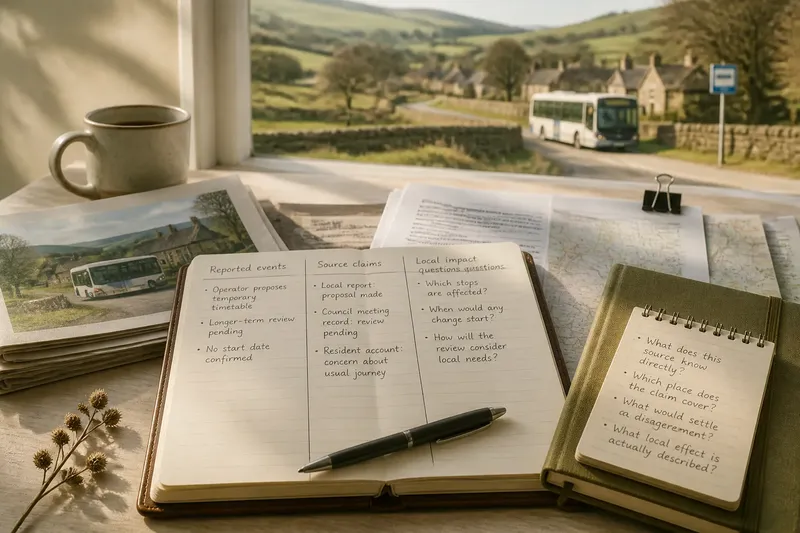
Think of your notes as a kitchen drawer with dividers. Put reported events, source claims and questions about local impact in separate places, so one does not stand in for another. The structure should make the story easier to read, not turn the session into a full investigation.
Read each source for what it can establish
Start with the latest account and identify its central claims. For each one, ask who is speaking, what evidence or document is cited, and whether the speaker has direct knowledge or is describing someone else’s account. A council notice may establish what has formally been decided; a resident’s account may describe an effect on daily travel. Those sources answer different questions.
Check whether the story distinguishes a proposal from an approved decision, a scheduled change from one already in force, and an official statement from independent reporting. If a report paraphrases a formal decision, look for the relevant notice or meeting record when it is available. A source’s position can be relevant context, but it does not by itself prove or disprove a claim.
Keep the original wording of important claims beside your note, or identify the document and date clearly. This helps you avoid turning a qualified statement into a certain one. If an account says a route “may” change, do not record that the route has changed.
Place claims in their local setting
Rural stories often depend on details that a broad label can hide: which settlement is affected, where a service stops, what route people use, or which authority is responsible. Check whether the report names the relevant place precisely. “The village” may not tell a reader whether the change concerns the centre, an outlying hamlet or a connection used by several communities.
Separate a documented local condition from a general assumption. A report about a road closure may identify the affected road, while leaving unclear how residents reach a nearby service. Do not fill that gap with a guess about distance, alternatives or residents’ needs. Record what the source says and what remains unreported.
Also notice whose experience is represented. An official account can explain a decision, while a local account can describe how it is encountered. Neither automatically covers every resident or settlement affected, so be precise about the scope of each source.
Distinguish evidence from missing information
Replace a broad note such as “nobody knows what is happening” with a specific gap: the notice gives no start date, the report does not name the affected stops, or the council statement does not explain how a temporary arrangement will be reviewed. A precise gap is less likely to be mistaken for a contradiction.
A conflict arises when sources make different claims about the same point. Record the point of disagreement, where each account appeared and whether either cites a relevant document. Leave it unresolved if the available material does not settle it; do not select the account that sounds more familiar.
Keep questions proportionate to the evidence. If the available material does not explain why a decision was made, note that the reason is not stated rather than inferring private motives. An outcome that affects one settlement does not, by itself, establish how decision-makers reached it.
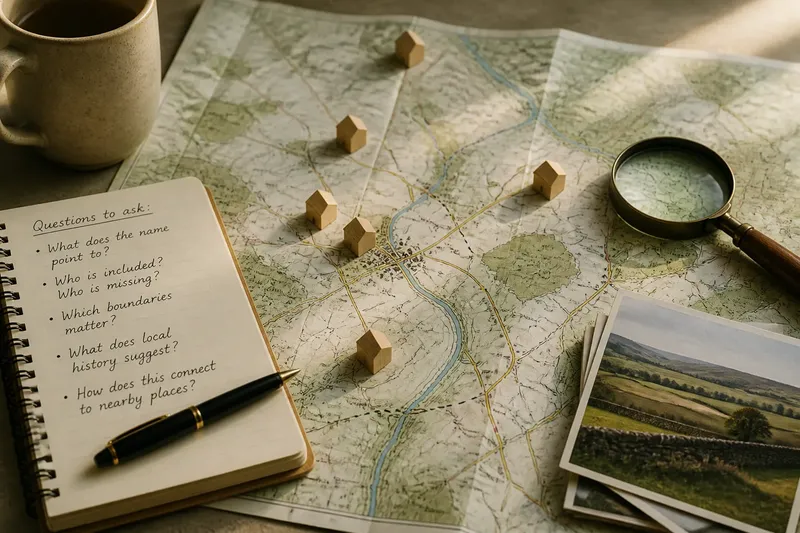
Questions to ask while reading a rural story?
What does this source know directly?
Identify whether the source is a named decision-maker, a document, a reporter or someone describing a personal experience. Then distinguish direct evidence from an account of what another person said.
Which place does the claim cover?
Check for the named settlement, road, service point or area in the report or source material. If the location is vague, record that limitation instead of assuming the claim applies to every nearby community.
What would settle a disagreement?
Name the disputed detail and the kind of evidence that could address it, such as a published notice, meeting record or direct clarification. If none is available, keep the disagreement open rather than treating repetition as confirmation.
What local effect is actually described?
Separate a formal change from accounts of its consequences for residents. If a source describes only the decision, do not present possible effects as observed facts.
Use a short worked example to test the reading
Say you are reading about a village bus route. For this invented example, the starting inputs are a local report saying the operator has proposed a temporary timetable, a council meeting record saying a longer-term review is pending, and a resident’s account that the proposed timetable would affect their usual journey. These inputs support different claims: the report describes a proposal, the record identifies an outstanding review, and the resident describes an anticipated personal effect.
First, write “temporary timetable proposed” rather than “timetable changed”, because the supplied account does not say it has taken effect. Next, note that the longer-term review remains pending because that is what the meeting record states. Then attribute the journey concern to the resident and avoid extending it to all passengers or settlements. The resulting answer is limited but useful: a proposal exists, the longer-term review is unresolved, and one resident has described a possible effect; the materials do not establish an implementation date or the impact on every user.
Leave a clear record of what the sources support
Close with a short dated note that separates the current account, source basis, local scope and unresolved points. Include the title or date of the document behind any formal claim, and identify personal accounts as such. Keep your interpretation visibly distinct from what the sources report.
- Source identity: If a claim names its speaker or document, record that source; if not, mark the attribution as unclear and avoid treating the claim as independently verified.
- Evidence cited: If the report links to a notice or meeting record, check whether it supports the stated decision; if it does not, record the gap and keep the claim provisional.
- Status of the change: If the wording says proposed or under review, describe it as pending; if a formal record says it is approved or in force, record that status and name the record.
- Place covered: If the material names the affected settlement, road or service point, include it; if the location is vague, state that scope is unclear rather than extending it to nearby places.
- Local experience: If a resident describes a personal effect, attribute it to that person; if no local experience is included, do not claim that the effect has been observed.
- Disagreement: If sources differ on a specific fact, record both sources and the disputed point; if a relevant document resolves it, update the note, otherwise leave it open.
- Next useful question: If a named meeting, notice or clarification could answer the remaining point, record that event or source; if no answerable next step is apparent, leave the question open without repeated checking.
A useful Sunday reading hour for one developing rural story ends with a sharper sense of what each source can support and where its account stops. Keep that distinction in your note: it will make the next report easier to assess without letting an official statement, a local experience or an unverified claim speak for the others.