The Latest-First Habit and the Missing Thread
A simple chronology helps you follow a developing rural story by showing how place, timing and decisions connect, without mistaking repeated details for change.
The common mistake with a developing rural story is to open the newest update first and treat it as the clearest account. That latest-first habit can leave you with a vivid detail but no thread: which place is involved, what decision came before it and what the report actually confirms.
A chronology is a sequence of events arranged by when they happened, rather than by where a website places them. For rural reporting, its value is not simply spotting repeated updates; it is reconnecting a headline to the local boundaries, decisions and people that give it meaning.
Find the local event behind the headline
Search results and news pages may put a fresh statement above the event it responds to. Before reading that statement as a complete account, identify its subject: a parish council decision, a planning application, a changed bus service or a road restriction.
Then distinguish the date of the event from the date of publication. A report published today may describe a meeting held earlier, while an older article may explain the policy or local dispute behind a new announcement.
Place names need the same care. “Near Ashford” might refer to a village, a road junction or a wider district; those are not interchangeable locations. Check the wording in the article and, where relevant, the named council, parish, route or service area.
Read rural place names at the right scale
Local stories often use several overlapping descriptions: a settlement, a parish, a county, a road and an administrative boundary. A headline may name the nearest well-known village even when the decision applies to a broader council area or a specific stretch of road.
Keep the location as precise as the source allows. If a report says only “the northern villages”, do not silently turn that into a claim about every settlement in the district. If two reports use different place names, check whether they describe different sites or simply different levels of geography.
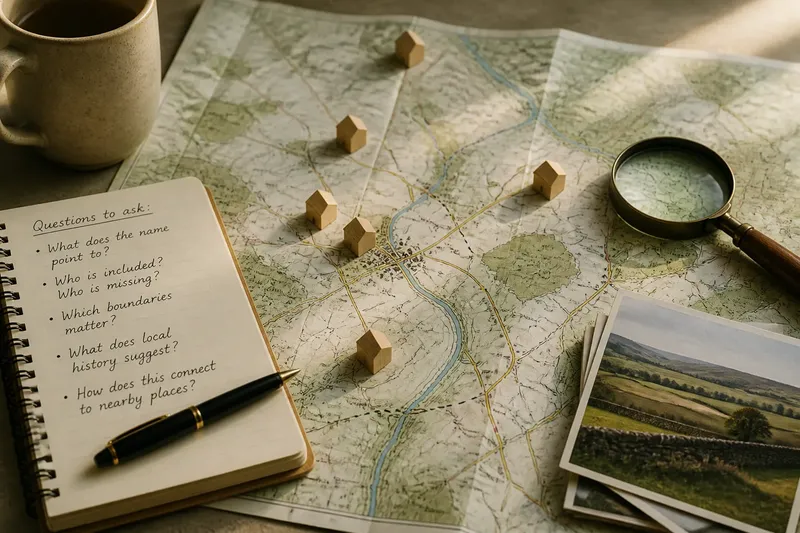
Think of a chronology as a paper map with pins: the order matters, but so does putting each pin in the right place. A sequence that merges neighbouring communities can make separate decisions look like one continuous dispute.
Connect decisions, responses and consequences
Rural stories often unfold through linked but distinct actions. A council may approve a proposal, a residents’ group may respond, and a service provider may later announce what it will do. The response is not itself the decision, and an announcement about a proposal is not proof that the change has taken effect.
For each entry, name the actor and the action. “Council approved the plan” is more useful than “plan approved” if the report identifies which council acted; “operator says it intends to alter the route” preserves the difference between an intention and an implemented change.
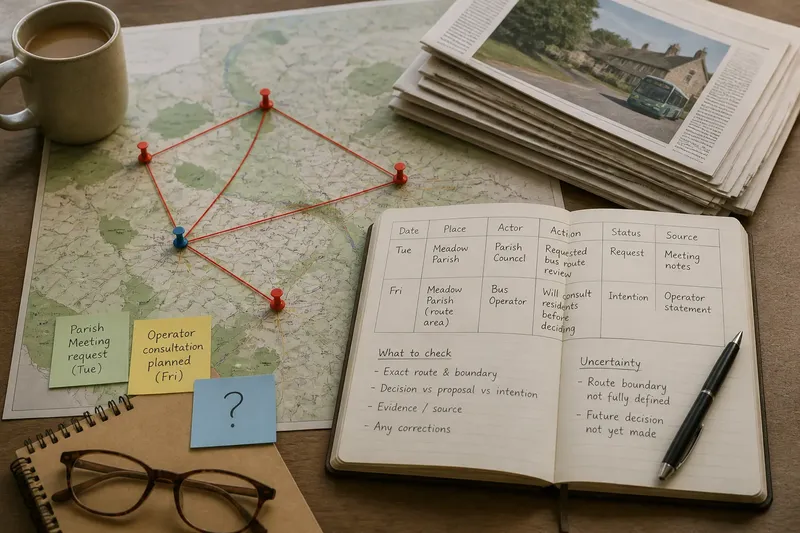
Say you are following a fictional report about a village bus route. The starting inputs are an article dated Tuesday that says a parish meeting requested a review, and a later article dated Friday that reports the operator will consult residents before deciding. First, record the meeting and its request as one event; next, record the operator’s stated consultation as a separate response, not a completed route change. The resulting account is that a review was requested and consultation is planned, while the route’s future remains undecided.
Use a compact record to keep local context intact
A short record can prevent a headline from flattening a complicated local story. For each item, capture the detail that changes how a reader should understand it, rather than copying whole paragraphs.
- Check the place name and boundary stated in the report; if it names a precise road, parish or service area, use that wording, but if it is vague, keep the location marked as unclear instead of assigning a nearby settlement.
- Check the event date separately from the publication date; if both are stated, record both, but if the event date is missing, mark it unstated rather than assuming it happened on publication day.
- Check who acted and what they did; if the report identifies a council, company or residents’ group, name that actor, but if it does not, attribute the action only to the report rather than guessing.
- Check whether a statement describes a decision, proposal or intention; if it confirms a decision, record it as decided, but if it describes a proposal or plan, keep its status open and look for a later formal outcome.
- Check what evidence supports the claim, such as meeting minutes, a named speaker or a public notice; if the source is identified, note it, but if it is not, treat the detail as attributed reporting rather than established fact.
- Check whether a correction changes a location, date or status; if it does, link the correction to the earlier wording, but if the reason is not given, record that gap without inventing an explanation.
These checks help you decide what belongs in the sequence and what remains uncertain. They also keep different kinds of information separate: a published council document, a resident’s account and a reporter’s description may all matter, but they do not play the same role.
What should you check before treating an update as a change?
Does a new headline mean a new decision?
No. Compare the action described in the article with the earlier account: a new headline may report a response, a meeting or a restatement without changing the original decision. Keep the distinction clear unless the report identifies a changed outcome.
How should you handle an unclear local boundary?
Use the most specific place wording the report provides and note what remains uncertain. If the boundary affects the story, check a relevant council document, map or official service notice rather than assuming nearby places share the same status.
What is the difference between a proposal and an implemented change?
A proposal describes something being considered; an implemented change is presented as having taken effect. Look for explicit wording about approval, commencement or delivery, and leave the status unresolved if the report does not establish it.
Which source should settle a current local status?
For the current status of a road restriction, public warning or service, consult the responsible council, operator or relevant authority. A news chronology can explain how the story developed, but it may not reflect conditions now.
Keep uncertainty attached to the detail
Early reports may use cautious language because a decision or location has not been confirmed. Preserve that uncertainty in your notes: “the council is considering a change” is not the same as “the council has approved a change”.
If a later report corrects an earlier detail, connect the correction to the claim it replaces. If the correction does not explain why the account changed, leave the reason open; a gap in the reporting is not an invitation to guess.
For a developing countryside story, the latest-first habit is useful only when it sends you back to the event, place and decision behind the update. Keep those details distinct, and a chronology can show not just what came next, but what the latest report actually means.