Why Rural Place Names Carry More Than Location
Rural place names orient readers and signal local identity; learn to spot the boundaries, histories and neighbouring communities a story may leave out.
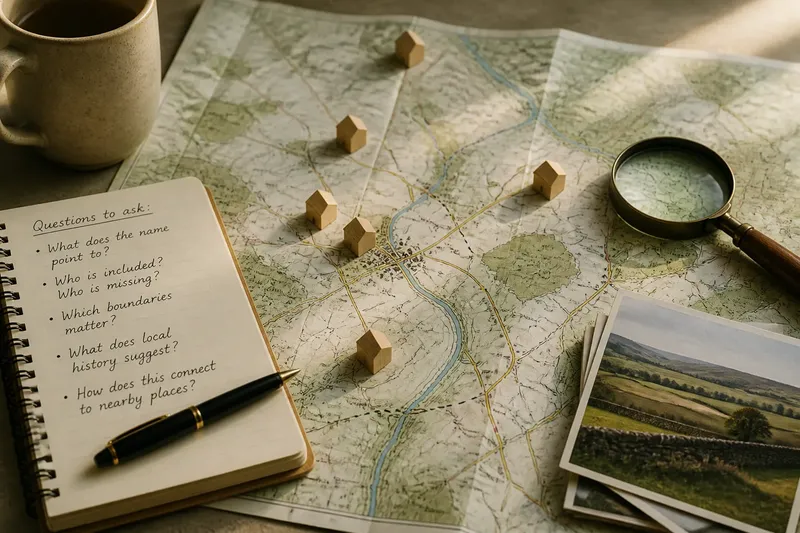
The common mistake in reading rural place names is to treat them as neutral pins on a map. A name can orient readers while quietly narrowing the story: it may suggest a shared identity, conceal a boundary dispute or leave nearby communities outside the frame. Reading it carefully helps you see who and what the article includes.
Here are five ways to read a place name as part of a story’s evidence, not just its address.
1. Check what the name points to
A rural place name might refer to a village, a parish, a valley, a farming district or a loosely understood area. These are not interchangeable. A village name gives a strong sense of a settled centre; a district name may cover scattered homes and fields; a parish name can reflect an administrative boundary that readers do not routinely use.
Look for clues in the article’s wording. Does it say “in the village”, “across the parish” or “near the market town”? Those phrases describe different scopes. A report about a planning application beside a village may affect a wider road network, while an article about a parish meeting may concern an area that includes several hamlets.
If the story gives only a broad label, avoid assuming that it identifies the exact site or every affected household. The place name may be useful for orientation without being precise enough to settle who is included.
2. Notice the identity the name invokes
Names can carry a sense of belonging. “The Dales”, for instance, may evoke a landscape and a set of local associations, even when a story concerns only one part of that wider area. A named village can make a report feel intimate and specific, while a county or region can frame the same issue as a shared concern.
That framing is not automatically misleading. It can help readers understand why a local decision matters to people who know the area. But a familiar label can also imply that residents form one voice. Rural communities contain different livelihoods, generations and views; a place name cannot establish consensus.
Separate what the name suggests from what the article actually reports. If a piece says “locals object”, ask whether it identifies residents, a local group or a handful of people speaking at a meeting. The place label supplies setting, not proof that everyone there agrees.
3. Look for the boundary the story leaves unstated
Many rural stories cross boundaries that a headline or opening paragraph does not mention. A river, parish line, school catchment or shared road can connect places that are described separately. Conversely, two locations with the same broad regional label may have distinct services, councils or interests.
Boundaries matter because responsibility and impact may fall in different places. A proposed facility might sit in one parish but use a lane travelled by residents of another. A change to a bus route could affect a cluster of settlements, although the report names only the town where the service begins.
Imagine a report about a new access road labelled with the nearest village. If the article later says the road joins a route used by two neighbouring hamlets, that detail changes the likely circle of affected people. The useful question is not simply “Where is it?” but “Which boundary is relevant to this part of the story?”
4. Treat local names as clues to history, not explanations
A place name may preserve an older feature, land use or local distinction. A hamlet, common, estate or parish can have a name that outlasts the conditions that gave it meaning. Such names may help readers recognise that a present-day story sits in a landscape shaped by earlier patterns of settlement or landholding.
Still, a name alone cannot explain that history. It does not tell you who held land, how boundaries changed or whether a community identifies with the label today. An article that uses a historic-sounding name without explaining its relevance may be relying on atmosphere rather than context.
Notice whether the story connects the name to verifiable details: a boundary shown on a map, an old route mentioned in a document, or a local institution that still uses it. If it offers no such connection, treat the name as a prompt for questions rather than a historical account.
5. Ask who disappears beyond the named place
Every place label draws a frame. Naming a market town can make it the centre of a story even when the issue affects outlying farms. Naming a village can make nearby settlements seem peripheral, although their residents may share a school, clinic, community hall or road.
Look for people and places just beyond the frame: commuters, seasonal workers, tenants, visitors, neighbouring parishes and residents who use local services without living in the named settlement. Their absence from one article does not prove they are affected, but it is a reason to check whether the account’s scope is narrower than the issue.
Names also have unequal familiarity. A nationally recognised landscape may be easy for an outside reader to place, while a small hamlet or local field name may be meaningful mainly to residents. A careful report can bridge that gap by giving a nearby landmark, the relevant council area or a short explanation of how the places connect.
What should readers ask about a rural place name?
Does the name identify a settlement or a wider area?
Check whether the article uses a village, parish, district or regional label, and note any wording that narrows the location. A broad name may orient you without showing exactly where an event happened.
Does the place name imply that residents share one view?
Look for named groups, attributed comments or meeting records rather than treating “the community” as a single speaker. The name tells you where those voices are located, not how widely they represent local opinion.
Could neighbouring places also be affected?
Follow the story’s references to roads, services, rivers or administrative boundaries. These links can show why the named settlement is only one part of the relevant area.
What would make the location clearer?
A map, a more precise locality, a named boundary or an explanation of the site’s relation to nearby settlements may resolve ambiguity. If the article provides none, keep that uncertainty in mind rather than filling it with assumption.
Read the name as a frame, not a full map
A place name works a little like a label on a storage box: it helps you find what is inside, but it cannot tell you everything the box excludes. In rural reporting, the label may orient readers and express local identity at the same time. Reading it well means asking what scale it names, what connections it suggests and which neighbours remain outside the frame.
When a rural place name catches your attention, use it as a starting point for checking the story’s boundaries and context. That small pause can reveal whether the article describes one settlement, a wider network of places or only the portion of a shared issue that fits its chosen name.